
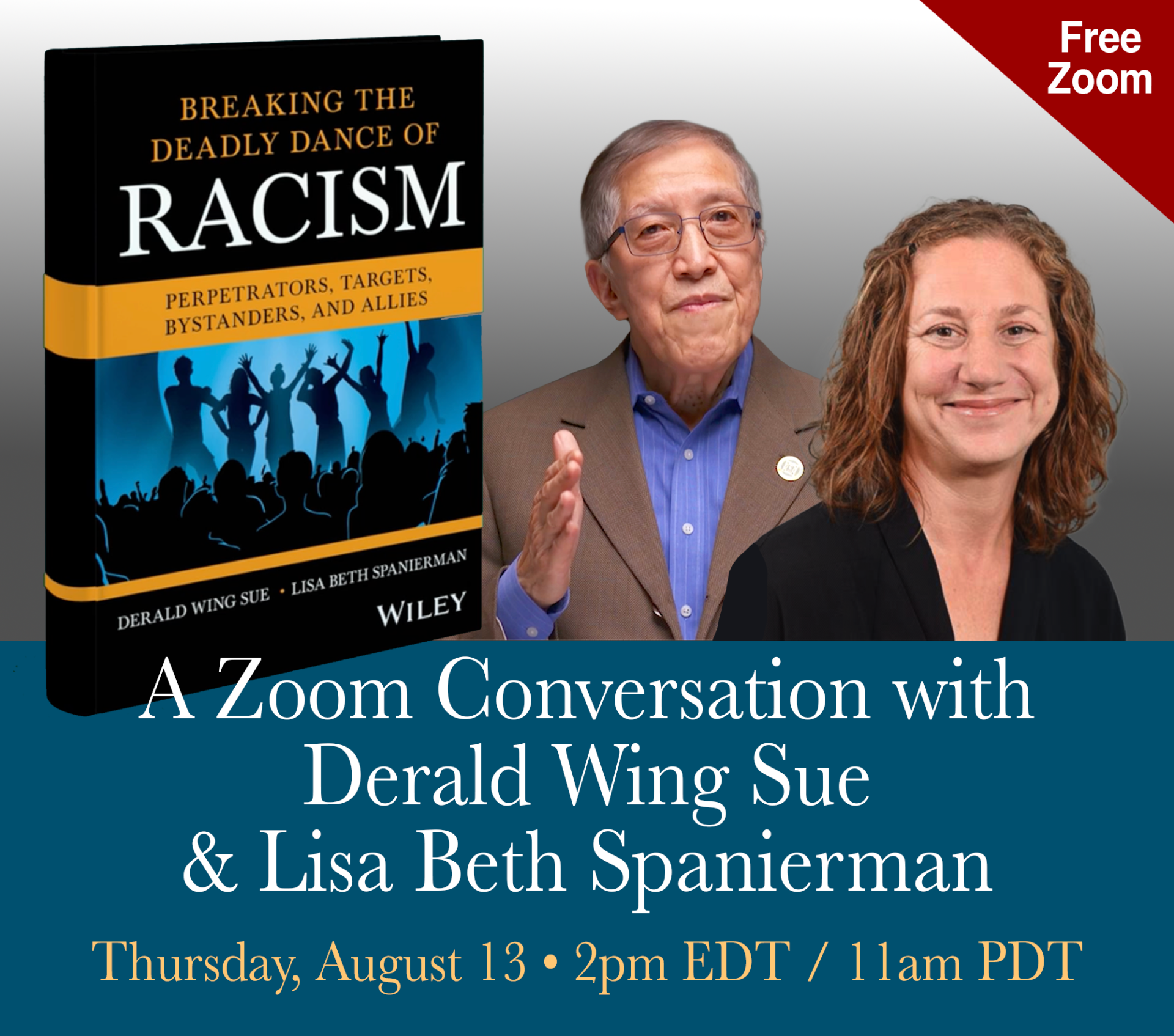
In this Zoom Webinar Dr. Sue and Dr. Spanierman will introduce their new book, Breaking the Deadly Dance of Racism.
They will discuss their research and focus on action - things we can all do right now.
They will share small, everyday tools that we can all use to disarm bias, interrupt racism, and shift harmful dynamics in real time.
Dr. Sue and Dr. Spanierman will also talk about why this book is so important right now in this time of challenges.
Dr. Derald Wing Sue is a renowned psychologist, author, and educator known for his groundbreaking work in multicultural counseling and the study of microaggressions. He is a professor at Teachers College, Columbia University.
Now, alongside co-author Dr. Lisa Spanierman, he brings this important work directly to you in a free Zoom webinar hosted by SunShower Learning and co-sponsored by Wiley.
As a proud co-sponsor, Wiley brings decades of trusted psychology and mental health publishing expertise to support a conversation designed to help participants put these insights into practice.
When racism happens in the room, most people freeze. Not because they don't care. Because no one taught them what to do next. Too often, racist incidents are met with silence. Perpetrators remain unaware, targets feel powerless, bystanders freeze, and allies hesitate.
Breaking the Deadly Dance of Racism, by Dr. Derald Wing Sue and Dr. Lisa Beth Spanierman provides a comprehensive framework for understanding how these four roles maintain racism and offers concrete intervention strategies.
In this live conversation, Dr. Sue and Dr. Spanierman will unpack the research behind their newest book and give you tools you can use as an educator or a practitioner.
Now, alongside co-author Dr. Lisa Spanierman, he brings this important work directly to you in a free Zoom webinar hosted by SunShower Learning and co-sponsored by Wiley.
As a proud co-sponsor, Wiley brings decades of trusted psychology and mental health publishing expertise to support a conversation designed to help participants put these insights into practice.
When racism happens in the room, most people freeze. Not because they don't care. Because no one taught them what to do next. Too often, racist incidents are met with silence. Perpetrators remain unaware, targets feel powerless, bystanders freeze, and allies hesitate.
Breaking the Deadly Dance of Racism, by Dr. Derald Wing Sue and Dr. Lisa Beth Spanierman provides a comprehensive framework for understanding how these four roles maintain racism and offers concrete intervention strategies.
In this live conversation, Dr. Sue and Dr. Spanierman will unpack the research behind their newest book and give you tools you can use as an educator or a practitioner.


This Webinar has been approved by HRCI
Credit Hours Awarded: 1.5Credit Type: HR (General)
Courses