
She Sat There Because of the 14th Amendment
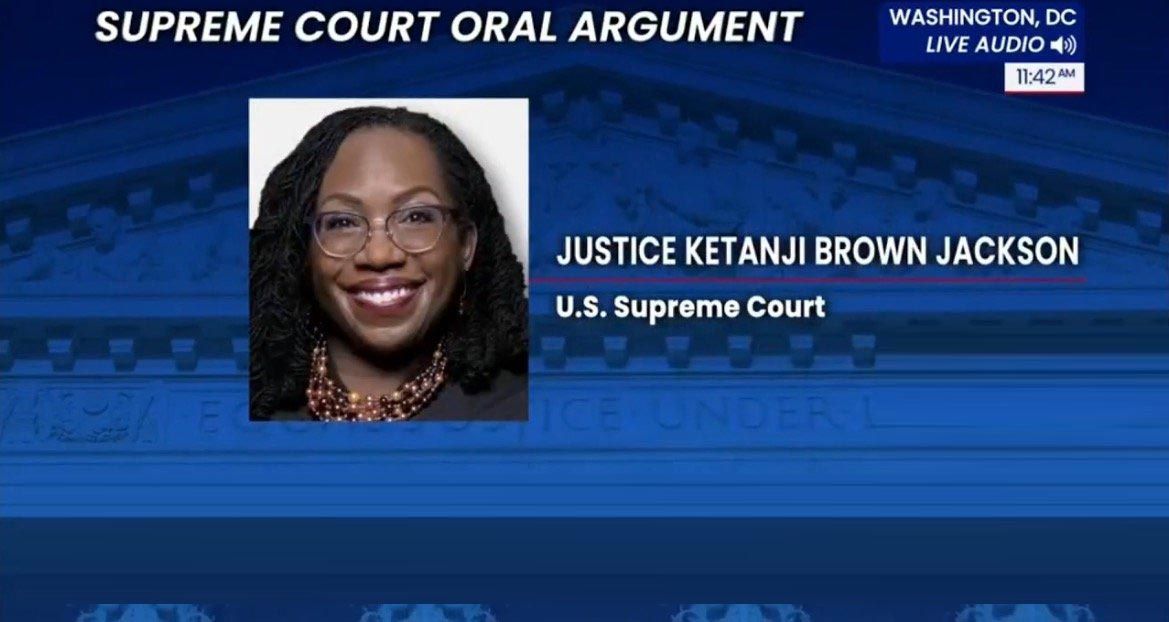
She sat there, listening.
Ketanji Brown Jackson, a Black woman, a descendant of people once legally defined as property in this country, now sits on the highest court in the United States. The same institution that once upheld the exclusion of her ancestors now depends on her interpretation of the law.
And in front of her, a lawyer argued that the 14th Amendment has been misread for 158 years.
Let’s be clear about what that moment actually was.
That wasn’t just legal argument. That was an attempt to rewrite history, to narrow belonging, and to reassert control over who gets to be recognized as fully human under the law.
The 14th Amendment did not emerge from intellectual debate or constitutional curiosity. It was born out of violence, resistance, and forced accountability.
After the Civil War, the United States faced a contradiction it could no longer ignore. It had built its wealth and political structure on the enslavement of Black people, while claiming to stand for freedom. The amendment was a response to that contradiction, not a resolution of it.
Formerly enslaved Black people, through rebellion, organizing, and sheer survival, forced the state to define them as citizens. Birthright citizenship was not an abstract principle. It was a direct intervention to stop states from continuing to deny Black people legal existence.
This matters because the story is constantly rewritten to make it seem neutral. It wasn’t neutral. It was demanded.
Justice Jackson’s presence on that bench carries that history.
Her grandparents were born into a country structured by segregation. Her parents came of age under Jim Crow. The distance between chattel slavery and a Black woman on the Supreme Court is not as long as this country likes to pretend.
She is not an isolated success story. She is the continuation of a lineage that endured intentional harm and forced structural change anyway.
Her presence is not proof that the system works as designed. It is proof that the system was challenged, pressured, and reshaped by people it was built to exclude. And now she sits there, listening to an argument that threatens the very foundation that made her citizenship possible.
The claim that the 14th Amendment has been “misread” is not new. It fits into a pattern that repeats across U.S. history.
Rights expand under pressure. Then power reorganizes itself and attempts to narrow them again.
This is what’s happening now.
The argument targeting birthright citizenship is not about technical interpretation. It is about control. If the state can redefine who is automatically a citizen, it regains the power to exclude at will.
That exclusion will not be random.
It will target immigrants. It will target communities already pushed to the edges. It will reinforce a hierarchy that was never dismantled, only legally challenged.
This is how power maintains itself. It rarely announces rollback as oppression. It frames it as correction.
There’s another layer that often gets erased.
When Black people forced the creation of the 14th Amendment, they didn’t just secure something for themselves. They expanded the floor of rights for everyone.
Birthright citizenship now protects millions of people, including immigrants and their children, people who were never part of the original constitutional imagination of this country.
This is how Black struggle operates in the United States.
It produces structural gains under extreme pressure. Those gains become protections that extend outward. Then the origin gets erased, and the protections are treated as if they were always neutral.
And once that erasure is complete, those same protections become easier to attack.
Because if people don’t understand where something came from, they won’t recognize when it’s being dismantled.
What makes this moment so stark is the proximity of history.
You have a Black woman, whose very existence in that role is tied to the 14th Amendment, sitting in judgment as someone argues that the amendment itself has been misunderstood for over a century.
That contradiction is not accidental. It exposes the tension at the center of this country. The law says one thing. Power continuously tries to reshape what that law actually means in practice.
And it often does so without needing open declarations of harm. Systems reproduce inequality even when individuals claim neutrality. Bias and structural conditioning shape outcomes regardless of intent .
Black gains became societal protection
That’s how something like this gets framed as a legal disagreement instead of what it is, an attempt to redraw the boundaries of belonging.
At this point, I want to emphasize again that the 14th Amendment exists because formerly enslaved Black people forced this country to confront its own violence. That wasn’t generosity. That was resistance reshaping law.
It’s important to name this as Black gains because power constantly erases who paid the cost. Enslavement, terror, legal exclusion, all of it built the conditions that made that amendment necessary.
At the same time, those Black gains expanded the floor of rights for everyone. Birthright citizenship doesn’t only protect Black people. It protects immigrants, their children, and anyone the state might try to exclude later. This is how white nationalism operates. Black struggle produces structural change. Then that change gets universalized. Then later, power tries to roll it back while pretending it was never specifically about Black liberation.
So the full truth is this: Black gains became societal protection. When people skip naming Black origins, it feeds erasure. When people ignore the broader impact, it limits the scale of what Black struggle actually achieved. Both have to be held at the same time, with accountability.
The most excluded force the system to change
The expansion of rights in this country has consistently come from those most excluded forcing the system to change. When those changes happen, they create broader protections that extend beyond the original struggle.
Ignoring the Black origin of those protections weakens them. Because it allows people to believe those rights were always stable, always agreed upon, always part of the design.
They weren’t. They were fought for. And they are still being fought over.
What happened in that courtroom is not an isolated moment.
It is part of a long pattern of contesting progress, of revisiting settled law to reassert control, of using legal language to reshape who counts and who doesn’t.
And sitting at the center of that moment was Justice Jackson. Not just as a judge, but as living evidence of what the 14th Amendment made possible. Her presence alone disrupts the argument being made. Because if the amendment had truly been “misread” all this time, she would not be there.
The question now is not whether the 14th Amendment was misunderstood.
The question is whether this country is willing to hold onto what Black struggle forced it to become, or whether it will continue the cycle of expansion followed by erasure and rollback.
Because that cycle is still active. And history is not something we look back on.
It is something we are watching unfold, in real time, in rooms like that one.
You can subscribe to my new newsletter!
Courses

Copyright © 2025