
The backlash against DEI and the rise of AI are not separate phenomena. They are the same move.
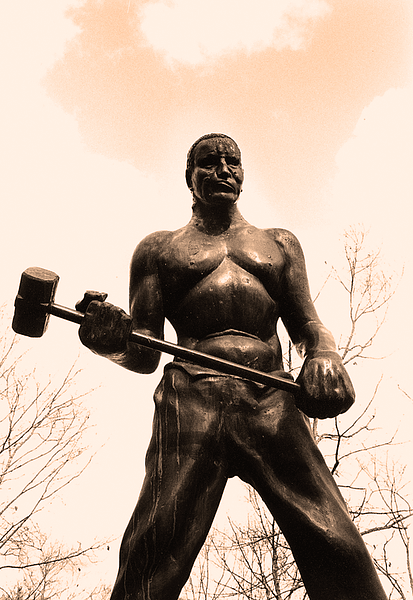
American folklore tells the story of John Henry, a Black man who drove steel for a living, hammering a metal drill into rock by hand to blast tunnels through mountains for the railroad. It was brutal, physical, dangerous work. In the legend, John Henry raced a newly invented steam-powered drilling machine to prove a man could outwork a machine. He won the race but he died from the effort, hammer still in hand.
Historian Scott Nelson discovered that John Henry was a real person, a nineteen-year-old from New Jersey, convicted of theft in a Virginia court in 1866 and sentenced to ten years in the penitentiary. He wasn't a free man who chose to race a machine.
He was a criminalized Black man, sentenced under a Jim Crow system that replaced slavery with incarceration the moment slavery was legally ended, and sent to build the C&O Railroad.
Prisoners like John Henry entered tunnels where microscopic rock dust floated in the air and eventually strangled them. These men died gasping for air. That's not a noble contest. That's extraction.
The work songs that turned Henry into a folk hero were not only memorializing him but they were also warning workers to slow down or die. The song was resistance. It was labor organizing passed mouth to mouth because writing it down was dangerous.
The legend of John Henry made a hero out of a prisoner and called it American pride. John Henry won the race but died anyway. Every era of technological progress has been built on labor it didn't credit and knowledge it didn't name.
That pattern didn't end with John Henry. AI is the latest continuation.
I had never heard the term John Henryism before I started researching this piece. It names a specific pattern: Black people exhausting themselves against systems built to outlast them. And this pattern isn't just historical, it's happening right now, in every workplace, every boardroom, every equity initiative that asks the people being harmed to also do the work of fixing the harm. I have seen this in my own work with organizations: the people being historically excluded and demeaned are asked to explain and fix the problems of the people harming them and the system that was never built for them.
Council and Ross saw this pattern operating inside the AI moment specifically, and they named it before almost anyone else did.
The Question Nobody Was Asking
Jayson Council and Dax-Devlon Ross are two strategists who have spent decades at the intersection of equity work, organizational transformation, and cross-sector leadership.
They work deep in the infrastructure of progressive organizations: voter protection groups, human rights organizations, immigration advocates, civil society builders. They are the people doing organizational culture work, values alignment, coaching, and long-range visioning for the people doing the visible work.
That vantage point, watching systems from the inside, across sectors, over decades, is what allowed them to see something most people are missing: the backlash against DEI and the rise of AI are not separate phenomena.
In a recent Forbes article, Ross argues, "It is not by coincidence that the delegitimization of DEI is happening in conjunction with the rise of AI. What it allows is for us to avoid having a conversation about what those implications are and how we're actually thinking about them long term."
The Battlefield Has Changed
Decades ago, machines replaced muscle. AI is beginning to replicate cognition. Now, technology is disrupting not just physical labor but the writers, analysts, lawyers, consultants, workers in all sectors. The white executive in rural West Virginia and the Black founder in Atlanta suddenly share a vulnerability they never had before: a machine that doesn't inherently have their best interests at heart.
Council and Ross call this the opening for something new. "When it becomes human to human, it's always us versus them," Council says. "But now, maybe for the first time, we can believe in ourselves together." I'm not sure I share their optimism, but I'll certainly hope for this.
Uneven Leverage
For generations, intellectual leverage was unevenly distributed. CEOs had research teams. Politicians had speechwriters. High-net-worth individuals had advisors and analysts. Everyone else worked alone.
AI disrupts that hierarchy. Today, a first-generation college student with a laptop has access to analytical assistance that rivals what only elites once possessed. That’s not cheating, it's access. Council and Ross call this closing the "assistant gap." It matters enormously for anyone building a Culture of Belonging.
But Access Alone Isn't Enough
Here's where the harder argument lives. Research by scholars like Joy Buolamwini and Timnit Gebru has documented how facial recognition systems misidentify darker-skinned women at dramatically higher rates than lighter-skinned men. Credit algorithms have been shown to replicate historical lending bias, scoring Black and brown applicants as higher risk not because of their actual finances, but because the data they were trained on reflects decades of discriminatory lending.
These are not optics problems. They are accuracy problems. Harm problems. And they are what happens when equity is treated as a post-launch audit rather than an inception-level design principle.
Without intentional integration of equity principles, AI doesn't become neutral. It becomes efficient at reproducing the past, which is deeply saturated with biased information. That is colonial logic running on new infrastructure.
DEAI: The Reorientation
Council and Ross coin the term DEAI: Diversity, Equity, and Inclusion in AI. This isn’t a rebrand, it’s a reorientation. The DEI lens, examining who is left out, who has power, whose worldview is embedded in systems, is exactly the lens needed to interrogate AI design, AI governance, and AI's implications for human labor."
Ain't nobody experts right now," Ross says plainly. "This stuff just got here and we don't even know how it's really working. So why can't the people who built an expertise in understanding disparities, in patterns of employment, housing, credit, why can't that knowledge be useful here?"
Wakanda
Council and Ross invoke Wakanda in their essay, not as wish-fulfillment. As a genuine model. Wakanda represents what it looks like when a culture's deepest values and knowledge systems are woven into its most advanced technology, rather than extracted from it or ignored by it.
t is the anti-John Henry: not a man running against progress, but a civilization that shapes progress in its own image. "Wakanda is an example of raging with the machine," Council says. "There is equity infused into the machine."
This question sits at the center of everything: whose worldview is embedded inside the AI systems that will soon mediate hiring, credit, healthcare, and education for billions of people?
That question has an answer being built right now, and Christian "ZacaTechO" Ortiz is building it.
American folklore tells the story of John Henry, a Black man who drove steel for a living, hammering a metal drill into rock by hand to blast tunnels through mountains for the railroad. It was brutal, physical, dangerous work. In the legend, John Henry raced a newly invented steam-powered drilling machine to prove a man could outwork a machine. He won the race but he died from the effort, hammer still in hand.
Historian Scott Nelson discovered that John Henry was a real person, a nineteen-year-old from New Jersey, convicted of theft in a Virginia court in 1866 and sentenced to ten years in the penitentiary. He wasn't a free man who chose to race a machine.
He was a criminalized Black man, sentenced under a Jim Crow system that replaced slavery with incarceration the moment slavery was legally ended, and sent to build the C&O Railroad.
Prisoners like John Henry entered tunnels where microscopic rock dust floated in the air and eventually strangled them. These men died gasping for air. That's not a noble contest. That's extraction.
The work songs that turned Henry into a folk hero were not only memorializing him but they were also warning workers to slow down or die. The song was resistance. It was labor organizing passed mouth to mouth because writing it down was dangerous.
The legend of John Henry made a hero out of a prisoner and called it American pride. John Henry won the race but died anyway. Every era of technological progress has been built on labor it didn't credit and knowledge it didn't name.
That pattern didn't end with John Henry. AI is the latest continuation.
I had never heard the term John Henryism before I started researching this piece. It names a specific pattern: Black people exhausting themselves against systems built to outlast them. And this pattern isn't just historical, it's happening right now, in every workplace, every boardroom, every equity initiative that asks the people being harmed to also do the work of fixing the harm. I have seen this in my own work with organizations: the people being historically excluded and demeaned are asked to explain and fix the problems of the people harming them and the system that was never built for them.
Council and Ross saw this pattern operating inside the AI moment specifically, and they named it before almost anyone else did.
The Question Nobody Was Asking
Jayson Council and Dax-Devlon Ross are two strategists who have spent decades at the intersection of equity work, organizational transformation, and cross-sector leadership.
They work deep in the infrastructure of progressive organizations: voter protection groups, human rights organizations, immigration advocates, civil society builders. They are the people doing organizational culture work, values alignment, coaching, and long-range visioning for the people doing the visible work.
That vantage point, watching systems from the inside, across sectors, over decades, is what allowed them to see something most people are missing: the backlash against DEI and the rise of AI are not separate phenomena.
In a recent Forbes article, Ross argues, "It is not by coincidence that the delegitimization of DEI is happening in conjunction with the rise of AI. What it allows is for us to avoid having a conversation about what those implications are and how we're actually thinking about them long term."
The Battlefield Has Changed
Decades ago, machines replaced muscle. AI is beginning to replicate cognition. Now, technology is disrupting not just physical labor but the writers, analysts, lawyers, consultants, workers in all sectors. The white executive in rural West Virginia and the Black founder in Atlanta suddenly share a vulnerability they never had before: a machine that doesn't inherently have their best interests at heart.
Council and Ross call this the opening for something new. "When it becomes human to human, it's always us versus them," Council says. "But now, maybe for the first time, we can believe in ourselves together." I'm not sure I share their optimism, but I'll certainly hope for this.
Uneven Leverage
For generations, intellectual leverage was unevenly distributed. CEOs had research teams. Politicians had speechwriters. High-net-worth individuals had advisors and analysts. Everyone else worked alone.
AI disrupts that hierarchy. Today, a first-generation college student with a laptop has access to analytical assistance that rivals what only elites once possessed. That’s not cheating, it's access. Council and Ross call this closing the "assistant gap." It matters enormously for anyone building a Culture of Belonging.
But Access Alone Isn't Enough
Here's where the harder argument lives. Research by scholars like Joy Buolamwini and Timnit Gebru has documented how facial recognition systems misidentify darker-skinned women at dramatically higher rates than lighter-skinned men. Credit algorithms have been shown to replicate historical lending bias, scoring Black and brown applicants as higher risk not because of their actual finances, but because the data they were trained on reflects decades of discriminatory lending.
These are not optics problems. They are accuracy problems. Harm problems. And they are what happens when equity is treated as a post-launch audit rather than an inception-level design principle.
Without intentional integration of equity principles, AI doesn't become neutral. It becomes efficient at reproducing the past, which is deeply saturated with biased information. That is colonial logic running on new infrastructure.
DEAI: The Reorientation
Council and Ross coin the term DEAI: Diversity, Equity, and Inclusion in AI. This isn’t a rebrand, it’s a reorientation. The DEI lens, examining who is left out, who has power, whose worldview is embedded in systems, is exactly the lens needed to interrogate AI design, AI governance, and AI's implications for human labor."
Ain't nobody experts right now," Ross says plainly. "This stuff just got here and we don't even know how it's really working. So why can't the people who built an expertise in understanding disparities, in patterns of employment, housing, credit, why can't that knowledge be useful here?"
Wakanda
Council and Ross invoke Wakanda in their essay, not as wish-fulfillment. As a genuine model. Wakanda represents what it looks like when a culture's deepest values and knowledge systems are woven into its most advanced technology, rather than extracted from it or ignored by it.
t is the anti-John Henry: not a man running against progress, but a civilization that shapes progress in its own image. "Wakanda is an example of raging with the machine," Council says. "There is equity infused into the machine."
This question sits at the center of everything: whose worldview is embedded inside the AI systems that will soon mediate hiring, credit, healthcare, and education for billions of people?
That question has an answer being built right now, and Christian "ZacaTechO" Ortiz is building it.

Courses